



 By
By 
What is the service and why is the government introducing it?
The Register your rental property service is a new national register created by the Renters’ Rights Act 2025. MHCLG describes it as a “one stop shop” for landlords, giving them access to guidance through a single “front door” to help them understand their obligations and demonstrate compliance.
For tenants, it is intended to increase transparency and give them better information before they decide to rent a property and throughout their tenancy.
For local councils, it is meant to provide a trusted, consistent source of data that removes the administrative burden of identifying poor-quality or non-compliant properties, freeing council staff to focus on enforcement.
Will the Database replace the existing Rogue Landlord list?
MHCLG’s stated intention is for the PRS Database to replace the functionality of the Rogue Landlord List as it relates to private sector landlords, with certain offence-related details made viewable to tenants and prospective tenants.
Key Requirements
Who has to register?
All landlords in England of assured periodic tenancies are legally required to register themselves and their properties on the Database. This does not only relate to landlords who are individuals, but Limited Companies and other entities that qualify as ‘landlords’.
There are exemptions – landlords of supported exempt accommodation as set out in the Supported Housing (Regulatory Oversight) Act 2023. Check if the exemption applies – Section 12 of the Act.
What information will landlords need to provide?
Landlords must record details of their each of their properties:
- the address
- the number of residents and bedrooms
- the amount of rent they are receiving for a property
Landlords must also demonstrate they meet health and safety standards by uploading gas, electric, and energy performance certificates.
A full detailed list of the information required is available on the Government website.
If the landlord uses a letting agent, the landlord MUST start the registration process themselves; however, there will be an option for your agent to upload certain information on the landlord’s behalf.
Further guidance will be published for letting agents on how this will work ahead of service rollout. To be notified when new guidance is published, you can sign up to GOV.UK Alerts.
Is there a fee to register?
Yes. There’s an annual registration fee of £65 PER PROPERTY, and landlords must renew their registration each year. If landlords do NOT register their properties, they will risk being fined. Offline registration routes will be available for landlords who need them.
What information will be made public?
MHCLG says this is to be determined and will be set out in regulations, but is expected to include information related to property standards. Any data relating to the landlord will not be made available in the public domain.
Will the Database replace selective licensing?
No. MHCLG has confirmed selective licensing remains a valuable tool for local authorities.
When can landlords register?
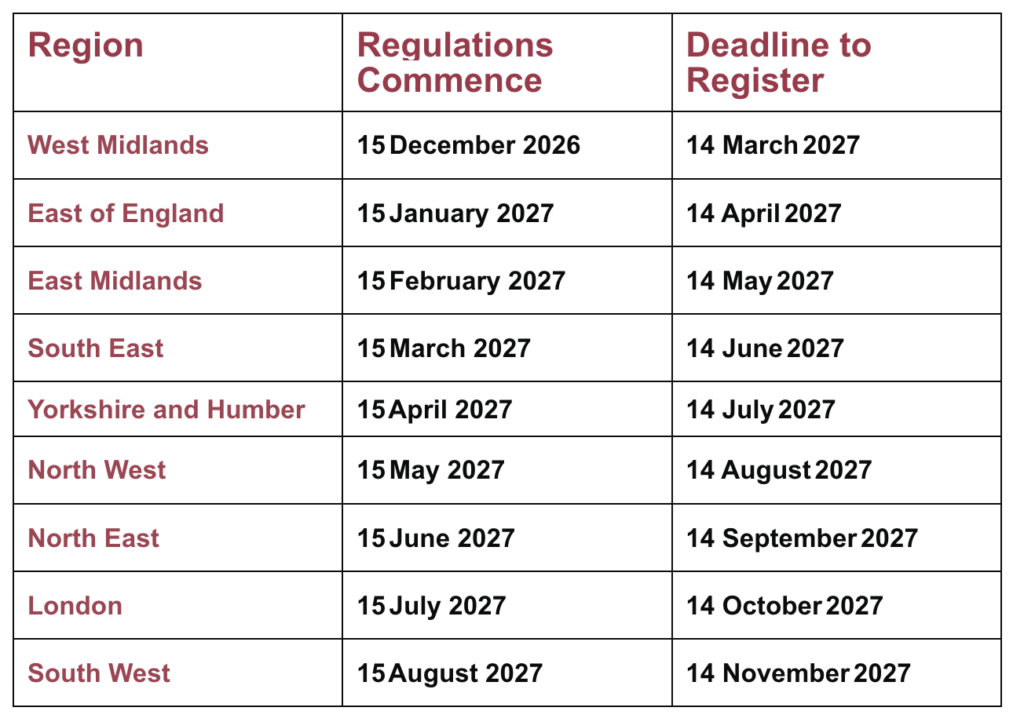
The service will roll out on a regional basis from 15th December 2026. This is intended to avoid bottlenecks in the service that could arise were all landlords required to register and renew properties on the same date.
To achieve this, the requirement to register will be staggered according to the region in which a property is located. This means the registration requirement will come into force for properties in different parts of the country on a rolling monthly basis. Once properties in a particular region become subject to the requirement, landlords will have a three-month window in which to register. Where registration has not been completed by this deadline, local authorities in that region will be able to initiate enforcement activity.
This rollout timetable applies to the date from which registration becomes a legal requirement. Landlords who wish to register before they are required to do so — including those who let properties across multiple regions and would prefer to register them all at the same time — will be able to do so.
Getting Prepared
How will registration relate to a landlord’s ability to gain possession of a property?
MHCLG’s guide states that landlords in breach of the duty to register will not be able to obtain a possession order, except where the ground relied upon is Ground 7A or Ground 14. MHCLG a;so confirms this restriction is designed to be recoverable — MHCLG has said it will ensure landlords are always able to rectify non-compliance so they are not prevented from regaining possession indefinitely.
Ongoing Learning
The Renters’ Rights Act has been one of the biggest changes we have seen within the private rented sector for over 30 years. Since 1st May 2026, key changes came into play and with the second phase rolling out, professionalism and compliance with the Act and new legislation is essential as a landlord.
Available anytime, anywhere through the LIS Community Hub, I’m delighted to have produced a comprehensive 15-section training course, created in partnership with the National Landlord Investment Show, providing landlords the practical knowledge they need to understand their responsibilities and how the Act works in practice.
Don’t wait until the last minute to prepare for the registration deadline. Find out how to access the training today.
Fines and Penalties
What happens if a landlord lets or advertises a property without registering it?
Local authorities will issue a civil penalty of up to £7,000.00 for an initial breach.
What happens for repeated or more serious breaches?
Where a landlord repeatedly breaches the registration requirement, or commits a serious offence such as providing fraudulent information, they may face a civil penalty of up to £40,000.00 or criminal prosecution.
Can a rent repayment order apply to Database breaches?
Yes. MHCLG’s guide lists two database-related offences where a rent repayment order can be sought for providing false information and continued failure to register after a financial penalty has already been imposed for that failure.
Is this enforcement approach consistent with how MHCLG will deal with other breaches under the Act?
Yes. MHCLG describes a general enforcement framework across the Act of up to £7,000.00 for first or minor non-compliance and up to £40,000 for serious, persistent or repeat non-compliance, with criminal prosecution and an unlimited fine as an alternative route for the most serious cases. The Database penalties sit within that same structure.












Comments