



 By
By Is it really a ‘big shake up’, or has it backfired on tenants?
On May 1st, the so-called ‘biggest shake-up’ of renting and letting a home became law with the Renters’ Rights Act. But what has actually happened since then?
Has it made life better for tenants? Has it caused problems for landlords and letting agents? And have any of the biggest worries and fears about the new rules come true?
At this stage, the honest answer is that it is still too early to make firm conclusions. The full impact of the Renters’ Rights Act has not yet worked its way through the market, and other changes, such as the landlord database, are still to come.
However, we are already starting to see early feedback from landlords, letting agents, tenants and property experts. So far, the picture is mixed.
Some concerns appear to be valid. Others may have been overstated. And in some cases, the outcome may depend on where you are in the country, what type of property is being rented, and how landlords respond over the coming months.
Have the biggest predictions come true?
Before the Renters’ Rights Act became law, there were five main worries about how it could affect the rental market.
These included concerns about:
- Landlords leaving the market
- Rents rising further
- Rent rises will automatically be challenged by tenants in the courts
- Evictions would rise
- Court decision timings would be increased
So, have these predictions actually happened? Or were some of them more scare story than reality? Let’s look at the five biggest fears around the Renters’ Rights Act and what we know so far.
#1 Landlords would sell up
This depends who you talk to and indeed where in the country you are.
Hamptons’ latest data from their expert David Fell shows that over a period in June, the share of landlords selling has reduced, especially in London where it’s fallen from 23% to 20%.
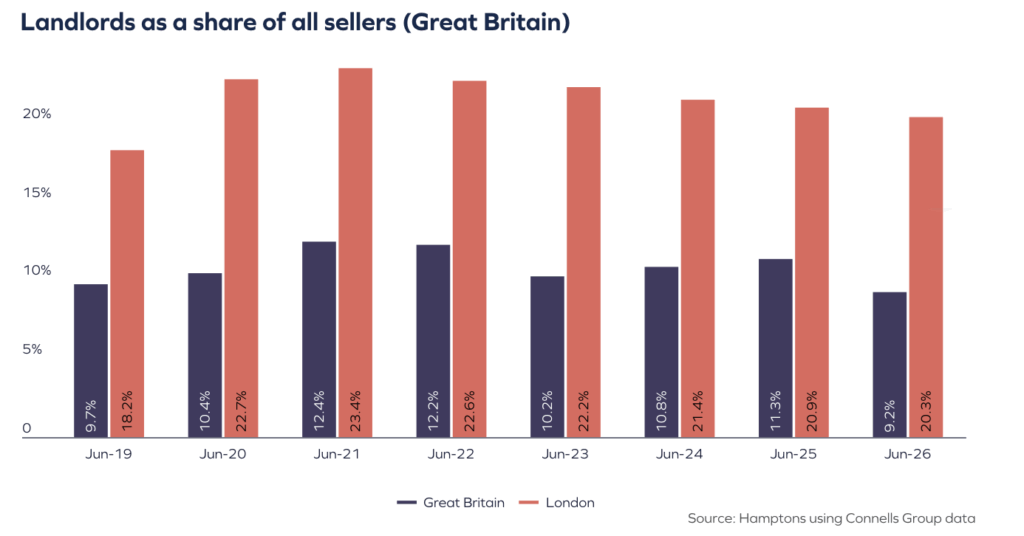
The reasons for this fall include:
- Many landlords have already sold: Years of tax, interest rate and regulatory pressures mean many landlords who intended to exit the market have already done so.
- The cost of failing to sell has increased: New rules preventing landlords from re-letting for 12 months after serving notice to sell make an unsuccessful sale significantly more costly.
- A slower sales market: Longer selling times and weaker demand—particularly for flats and in southern England—are making landlords more cautious about putting rental properties up for sale.
And on a regional basis, David explains:-
“In London, one in five homes listed for sale in June had previously been let within the last five years, at 20.3%. This was more than double the share recorded in the South East, where 9.5% of homes listed for sale had previously been rented.”
The data shows that although sales in London were much higher, so are the regions that are in the more expensive areas such as the South East and East of England, with the South West being on a bar with other regions.
Interestingly, Scotland and Wales which have been operating more stringent rental rules over the past few years are still seeing landlords selling, but at around a half to two thirds the average figure for most English regions.
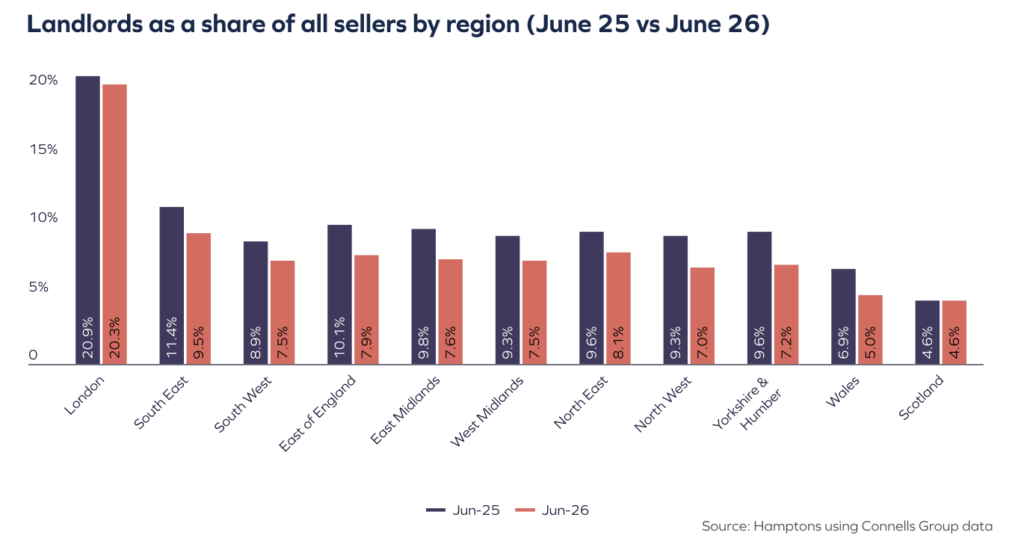
In conclusion, David suggests that landlords in the Midlands and North are more happy (and able) to as they are “less exposed to the profit pressures weighing on higher-value Southern markets.”
#2 Rents would rise rapidly
In view of the worries and fears of renting costing more and the impact of only being allowed to raise rents once on an annual basis, the predictions were that rents would be increased before 1st May while landlords had more freedom to increase rents, especially higher than market rates.
According to the latest analysis from Richard Donnell, Executive Director of Zoopla:
“The rental market is increasingly moving at two different speeds, with affordability shaping how quickly rents can rise. Lower-cost areas are seeing the strongest growth, with rents increasing by nearly 5% where average rents are below £750 a month, while some locations are recording annual increases of 7–9%. In contrast, rents are falling in cities including Birmingham and Nottingham, while growth in more expensive markets is constrained by affordability.
These local differences are particularly relevant following the introduction of the Renters’ Rights Act in England on 1 May, which requires landlords and agents to give advance notice of rent increases. With rental growth varying significantly across the country, local market conditions will play an increasingly important role in rent reviews and negotiations between landlords and tenants.”
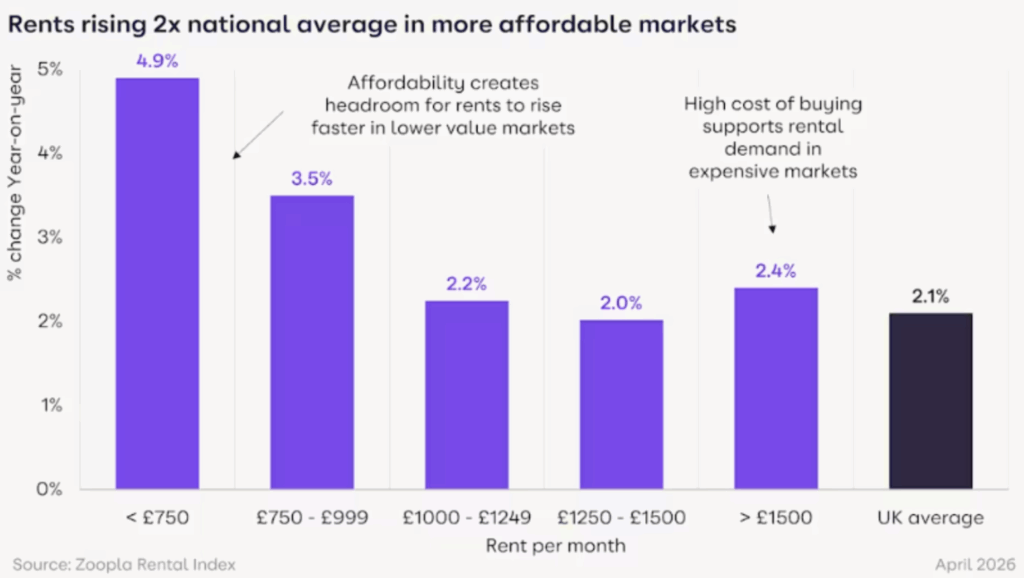
Richard concludes that “local market growth is an important factor in setting rents and in how negotiations play out in practice.” As a result, landlords are going to have to find a way to ensure their rental increase (however small) can be justified using robust statistics that a First Tier Tribunal or court will accept as evidence.
#3 Rent rises will automatically be challenged by tenants in the courts?
With tenants allowed to challenge rent increases at a cost of £47, which also means their rental increase is delayed. The only risk they take is that rental increase is passed by the courts – but its important to know that its not back dated.
As a result many thought all or most tenants will challenge their rent increases, but interestingly that doesn’t seem to be the case.
According to PropertyMark – the UK’s leading professional body for property agents, promoting high standards and consumer protection have published a great case study:-
Case study: A two-bedroom flat at Skylark Point, London, with rent of £3,102.82 pcm.
Proposed increase: The landlord sought £3,180 pcm, while the tenant argued for £3,040.
Evidence: The tenant used four advertised properties; the landlord provided nine actually agreed rents for comparable flats.
Tribunal decision: The landlord’s evidence carried more weight because it reflected achieved rather than advertised rents, and the £3,180 increase was approved.
The key takeaway from this is that the court appears to consider evidence from completed rental agreements is stronger than asking prices when determining market rent. However, as rents can only be advertised at their ‘final price’ this should mean that asking and completed rental agreements align a lot more.
Working with an agent can help to secure this type of information and PropertyMark have provided a useful list of information to secure if you are required to go to a Tribunal:
- recently achieved rents for comparable properties
- the location, size and type of each comparable home
- differences in condition, specification and furnishings
- photographs, floor plans and room sizes
- details of repairs, improvements and local amenities
- an explanation of how the proposed figure was reached.
It’s also apparently important to be clear on the condition of a property as the Tribunal should assess whether the property could “reasonably achieve on the open market” meaning “outstanding repairs or differences in the facilities” could influence the Tribunals decision.
Are you a landlord who wants to hear more from leading property experts on navigating rent increases and ongoing training under the Renters’ Rights Act? Get your free tickets to the National Landlord Investment Show in Bristol on 30th September 2026, Manchester on 14th October 2026 and London on 28th October 2026.
#4 and 5 Evictions would rise and court decision timings would be increased
Who else would we ask but the evictions expert Paul Shamplina!
Latest data and research from Paul who owns and runs Landlord Action are showing “possession instructions 28% higher than a year earlier”. According to Paul, this makes July 2026 “one of the firm’s busiest months of the past year” bar the spike seen before the Renters’ Rights Act was implemented.
It’s not a surprise that this happened, as landlords had to rush to beat the Section 21 deadline the courts imposed for the end of July which was the last time landlords could regain their let properties under the old rules.
Paul explains “The pressure created by the 31 July deadline was clear from the number of landlords contacting us throughout the month. Our phones were exceptionally busy, with staff working extended hours to handle as many enquiries as possible.”
He continued:
“Unfortunately, many landlords had left it until the final days to seek advice or progress a claim. Instructing a solicitor immediately before the deadline did not automatically mean a claim could be issued. Every case and every document had to be reviewed carefully because any error in the original notice or supporting paperwork could result in the claim being rejected.
“Meeting the deadline was only half the battle. Landlords rushed to get their claims issued in time, but they are now reliant on a court system that, in many areas, is already understaffed, under-resourced and struggling with existing caseloads. They now face a potentially lengthy wait for their claims to be processed, heard and, where necessary, enforced.”
One of the really interesting pieces of information that we will now get from stopping S21 is that landlords will now have to issue a Section 8 notice. Essentially, all the reasons why tenants are being asked to leave will be exposed, when previously these would have been hidden by issuing a Section 21.
In the long term, we will be able to see if fewer tenants are being issued notices, or if the number is similar, but it’s just that now the reason tenants were asked to leave will be exposed.
According to Paul’s data, of the new possession cases recorded in July:
- 39% involved rent-related grounds, including Grounds 8, 10 or 11.
- 30% of cases issued a Ground 1A notice, indicating they were going to sell.
- 8% were issued when the landlord or a member of their family intends to occupy the property.
- A further 29% involved other grounds. Some cases relied on more than one ground.
So far, the biggest reasons for landlords asking tenants to leave are predominantly rent-related, and landlords wanting to exit the sector.
To get latest updates on the impact of the Renters’ Rights Act and access ongoing learning and education, join the digital landlord community hub for free today.












Comments