



 By
By The Week’s Best Property News: In Review
25th September 2026
Each week, we carefully review and hand-pick the most important and reliable property stories from across the media from the 14th-20th September.
So if you’re a buyer, seller, landlord, tenant, property investor, or property professional working within the industry, the latest roundup of news stories will help you understand what’s really happening in the UK property market now and what’s ahead…
#1 Great expert analysis of the first 25 FTT rent cases by David Smith
Published by David Smith, Legal Expert
David Smith’s review of the first 25 published First-tier Tribunal rent cases since the Renters’ Rights Act changes suggests landlords are generally securing most or all of the rent increases they request, with half of determined cases awarding 100% of the proposed figure and a median increase of 6.9%. However, larger increases are receiving greater scrutiny, and the evidence so far suggests landlords are more likely to succeed where increases are moderate and supported by actual achieved rents rather than simply advertised portal prices.
You can read David’s full review here.
#2 Local landlord licensing schemes expand and penalties increase
Reported by Propertymark
Propertymark published a reminder of the importance of checking Landlord Licensing as from 1st May 2026, maximum civil penalties for relevant Housing Act offences rose from £30,000 to £40,000, while failure to license a property can also result in rent repayment orders of up to two years’ rent Propertymark. Alongside this, landlords are urged to stay ahead of local licensing scheme expansions.
Read more about updates to landlord licensing schemes here.
#3 Leaseholders handed Right to Manage boost by Supreme Court ruling
Reported by Leasehold Advisory Service.
The Supreme Court has ruled that procedural errors do not necessarily invalidate a leaseholders’ Right to Manage claim. In this case, the RTM company failed to invite one qualifying leaseholder to participate and did not comply with the associated 14-day period, but the Court unanimously held these were procedural requirements and did not remove the company’s entitlement to acquire the Right to Manage, although the statutory procedures must still be followed.
Read more about the case here.
#4 Housebuilding falls further behind target – and London is struggling most
Published by Russell Curtis, Founding Director, RCKa, Mayor’s Design Advocate, Chair, Barnet QRP
Russell Curtis highlights MHCLG’s latest housing data as further evidence of the scale of England’s housebuilding challenge, with delivery particularly weak in London and the South East. His wider analysis of the Housing Delivery Test shows that 91 planning authorities are now subject to the ‘presumption in favour of sustainable development’ for under-delivery, including 21 of London’s 33 authorities – reinforcing how far actual housing delivery remains from stated ambitions.
The really shocking bit:
- Four councils now spend more on homelessness than they raise in council tax. Fourteen of them spend more than half of it; 46 spend more than a quarter. Across England, the bill equals 5.3% of everything councils raise in council tax.
Read Russell’s comments here and the full analysis of England’s homelessness bill here.
#5 Frozen housing support is pushing councils and low-income renters to breaking point
Reported by Joanne Drew, Executive Director – Housing and Regeneration, London Borough of Enfield
Joanne argues it is time to review Local Housing Allowance (LHA) as housing support increasingly fails to keep pace with private rents, contributing to homelessness and council temporary accommodation pressures. She also highlights the outdated temporary accommodation subsidy, under which councils can claim only 90% of the relevant 2011 LHA rate, while pointing to Resolution Foundation analysis suggesting that most of the benefit from bringing LHA back into line with rents would go directly to tenants.
Read Joanna’s full commentary on the need to review Local Housing Allowance here.
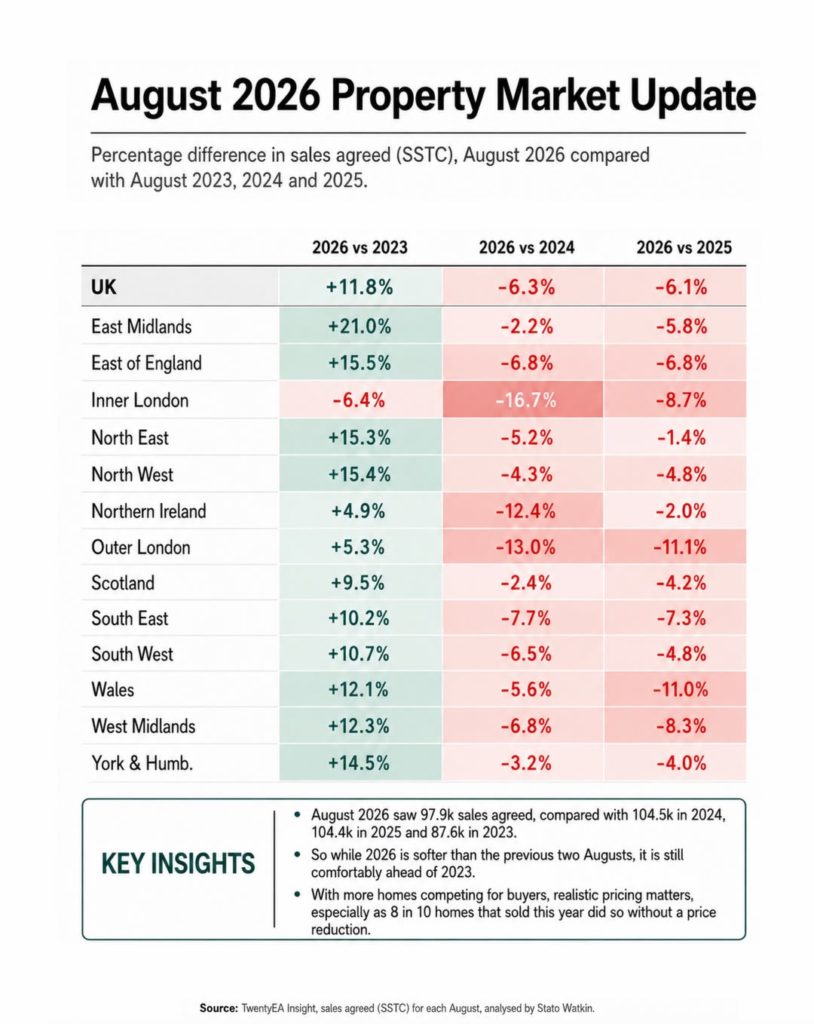
#6 UK property sales down 4% in Yorkshire and Humber but 11% in Wales and Outer London – why the year on year figures don’t tell the whole story
UK property sales are reportedly down year on year, but the headline figures don’t tell the whole story, and there are some big differences depending on where you live. Sales are down by around 4% in Yorkshire and the Humber, compared with falls of around 11% in Outer London and Wales.
At first glance, that might suggest the property market is weakening. But year-on-year comparisons can be misleading, particularly because the market was relatively busy at the same point last year. Look further back, and the picture changes considerably. Compare 2026 property sales with 2023, rather than just 2025, and most regions are recording double-digit increases in sales, with Inner London the exception.
Source: FB – Christopher Watkin
There is another important factor affecting today’s housing market: the number of homes for sale.
Buyers currently have more choice, with more properties on the market than we’ve seen for over a decade. That means sellers face much more competition and getting the asking price right from the start is increasingly important.
Well-priced properties are selling, and we’re still expecting around the long-term average of 1.2 million property transactions this year. However, with such a large number of homes competing for buyers, around half of properties listed by agents may not successfully sell.
So, are property sales falling in 2026?
Compared with a particularly active 2025, yes. But compared with the quieter market of 2023, most regions are seeing substantially more sales.
That’s why a single year-on-year figure rarely tells you whether your local property market is genuinely getting better or worse. For buyers and sellers, what’s happening locally, and over several years, is far more useful than the national headline.
#7 Are councils overwhelmed and understaffed to deliver benefits from Licensing?
Published by Richard Tacagni, London Property Licensing
Richard Tacagni, Managing Director at London Property Licensing, warns that some councils appear to be overwhelmed by the volume of work created by expanded property licensing schemes, with correspondence unanswered and promised response deadlines being missed. He highlights a case where a property changed ownership while the original licence application was still outstanding, leaving the new landlord unable to apply for a licence and attempts to resolve the problem unanswered for six months – potentially leaving landlords facing compliance problems through no fault of their own.
Read more about Richard’s comments here.
# 8 New landlord safety checklist from MHCLG launched as fines rise to £40,000
Reported by Helen Gregory, LandlordZone
The government has published a new HHSRS self-assessment checklist to help landlords and agents identify potential safety hazards, covering everything from damp and mould and fire safety to heating, ventilation, structural problems and security. The checklist isn’t mandatory, but could help landlords identify problems before enforcement action is needed – particularly important as penalties can reach £7,000 for failing to tackle serious hazards and £40,000 for breaching an improvement notice for relevant offences committed from 1 May 2026.
Read the full news story from LandlordZone here.
#9 More budget rumours: Could the ‘mansion tax’ threshold fall to £1.5m? 62,000 more London homes could be caught
Reported by Nicholas Cecil, Chief Reporter, The Standard
The Treasury is reportedly considering lowering the threshold for the new high-value property levy from £2 million to £1.5 million, although the Government stresses that no decision has yet been made. Analysis from Tax Policy Associates suggests this could bring around 122,000 additional properties into the tax nationally, including nearly 62,000 in London, with London homeowners potentially facing a combined annual bill of around £624 million.
The impact would be particularly concentrated in Hammersmith & Fulham, Wandsworth, Kensington & Chelsea, Westminster and Camden, raising concerns about the effect on London’s already weakening higher-value housing market.
Read the full story published by the Standard here.
#10 New crackdown on cowboy builders: payments to be protected as work is completed and new oversight of Bailiffs
Published by GOV.UK
The government has announced new measures designed to protect households from rogue builders and poor-quality home improvement work. From September, a government-supported scheme will help consumers identify traders signed up to an Approved Code, while a new payment system will allow customers’ money to be protected and released in stages as agreed building milestones are completed. Additionally, the government wants to tackle aggressive bailiffs and has called for the introduction of independent oversight to be made mandatory for private bailiffs in England and Wales, requiring them to be accredited by the Enforcement Conduct Board themselves.
Read the full government press release announcement here.



















Comments