



 By
By Our latest April/May economic update suggests the property market is still proving resilient, but the wider economic backdrop is becoming more uncertain. The key issue is that global events are affecting inflation, borrowing costs, household confidence and, ultimately, the housing market.
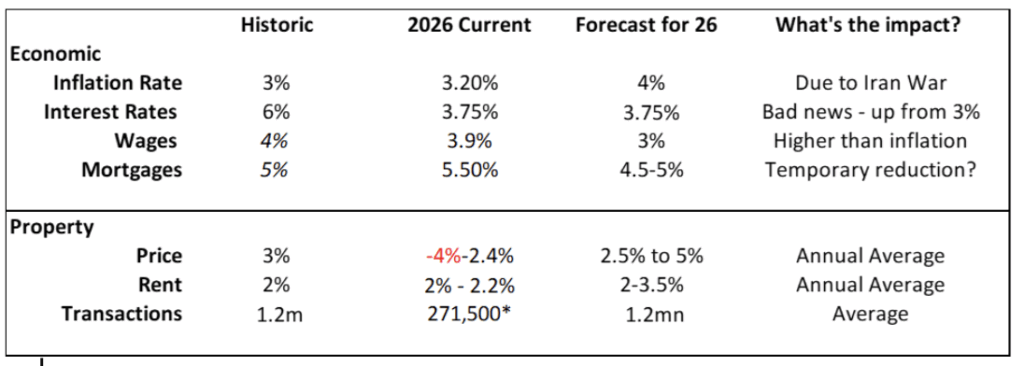
Data table- April/May 2026 data
The updated report highlights concerns around the conflict in West Asia, energy costs, borrowing costs and the potential longer-term impact on supply chains and producer inflation.
Rising inflation and its wider impact
Inflation has eased this month, but it’s expected to be a one off due to the falls in energy prices, but the latest commentary suggests price pressures could rise again if energy costs and global supply issues continue to feed through.
This matters because inflation does not just affect fuel bills. It can also increase:
- Transport costs
- Production costs
- Fertiliser costs
- Food prices
- Business costs
- Household bills
For the property market, the concern is that higher inflation can keep interest rates higher for longer. That affects mortgage rates, buyer and tenant affordability – and confidence.
Interest rates and affordability remain key
The report states that the current official Bank Rate is 3.75%. The decision to hold this rate was maintained in the latest MPC meeting held by the Bank of England on 18th June 2026.
Although this is lower than the peak seen in recent years, borrowing costs are still much higher than many buyers, landlords and homeowners became used to during the long period of ultra-low interest rates.
This means affordability is still stretched, especially for:
- First-time buyers
- Highly leveraged landlords
- Home movers in higher-priced areas
- Buyers in London and the South East
- Households remortgaging from cheaper fixed-rate deals
The property market is not necessarily behaving unusually by historic standards, but compared with the pre-inflation surge years, it feels much tougher.
Consumer confidence is still fragile
Consumer confidence improved slightly in May, with the overall index score increasing by two points to -23. However, this also highlights weaker major purchase intentions and pressure on savings, suggesting many households are still cautious.
This matters for the housing market because buying a property is one of the biggest financial commitments people make. If consumers are worried about day-to-day costs, savings or future interest rates, they may delay moving.
Just when it felt like 2026 might be a more settled year, events have shifted yet again. But there is always good news for someone in the property market and for those looking to buy, we are seeing the largest choice of properties available and with less confident movers, this means there are potentially some great deals to be had.
What the latest data does and does not show
It is important to remember though that this property data often lags behind real-world events.
Many of the latest property indices are based on activity from March, April or May, depending on the source. That means they may not yet fully reflect more recent global and economic changes.
The latest indices show a mixed picture:
- Rightmove says the housing market remains confident, but there is a clear divide between price growth in the North and South.
- RICS reports that higher mortgage rates continue to dampen buyer demand.
- Home.co.uk reports a sales stock surge while London prices slide.
- Nationwide says house price growth remained resilient in April.
- Halifax says house prices remained broadly stable in April.
- e.surv says prices are still rising, but slowly.
- Zoopla says buyer demand rebounded after Easter as lenders started to ease mortgage rates.
What does this mean for landlords and homeowners?
For landlords and homeowners, the key message is not to panic, but not to ignore the risks either.
The market is still moving. Sales are still happening. Buyers are still active where affordability allows. But pricing, finance and local market knowledge matter more than ever.
Landlords should be checking whether:
- Their rents are keeping pace with costs
- Mortgage payments remain affordable
- Their properties are still attractive locally
- They are overexposed to weaker markets
- Their portfolio is performing after inflation
Homeowners thinking of selling need to be realistic. What our latest data highlights is that buyer choice is increasing, and homes that need price reductions can take much longer to sell, so it’s much better to price it right in the first place, or you could simply end up not selling at all.
Overall outlook
The housing market has proved resilient through several major shocks in recent years. However, the latest update suggests 2026 may be less settled than hoped.
The market is not falling apart, but it is more sensitive to:
- Inflation
- Mortgage rates
- Consumer confidence
- Energy prices
- Global events
- Local supply and demand
For now, the sensible approach is to be aware of these trends, but to speak to local brokers, agents and surveyors to get a idea of whats actually happening in your local market.
Do you want more information on how the economy is impacting the property market and the latest forecasts for 2026? Join our free LIS Communtiy Hub. The free digital community hub for UK landlords, property investors and developers to access expert advice, property insights, and on-demand webinars & training.
Join the FREE LIS Community Hub
















Comments